
The $47,000 Question That Changed My Perspective
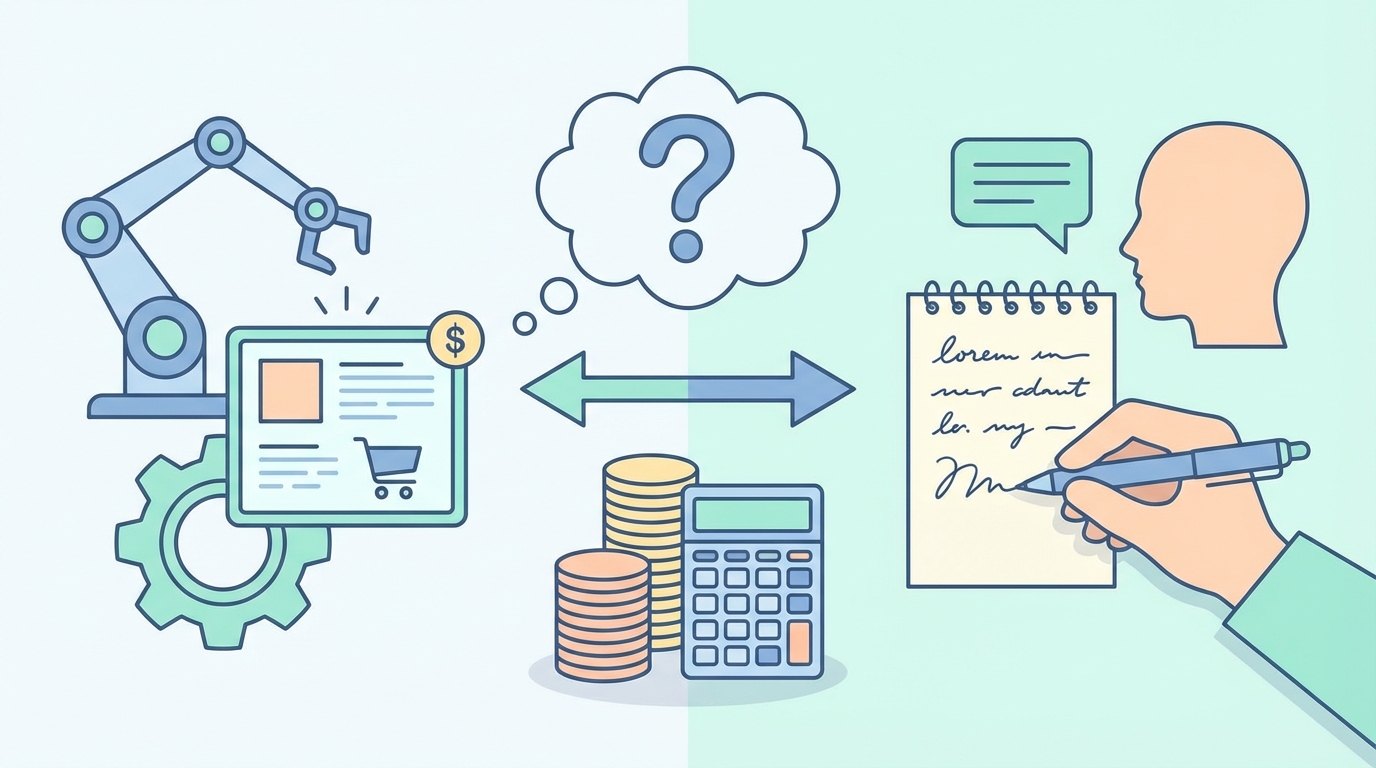
Last month, a seller in my mastermind group dropped $47,000 on product descriptions. 500 SKUs, professional copywriter, six weeks of back-and-forth revisions. The kicker? Their conversion rate dropped 3%.
Meanwhile, another member cranked out 2,000 descriptions in two days using AI tools. Cost: $99 for the premium plan. Conversion rate? Up 7%.
Before you fire your copywriter or cancel your AI subscriptions, let me show you what's really happening here.
The Real Cost Breakdown Nobody Shows You

Let's cut through the marketing fluff and look at actual numbers for a 100-product catalog:
Professional Copywriter:
- Rate: $75-150 per description (experienced e-commerce writer)
- Timeline: 2-3 weeks
- Revisions: Usually 2 rounds included
- Total: $7,500-15,000
AI Product Description Generator:
- Monthly subscription: $29-99
- Time per description: 30 seconds to 2 minutes
- Revisions: Unlimited regenerations
- Total: Under $100
But here's where it gets interesting. Those numbers tell maybe 20% of the story.
When AI Demolishes Human Writers (With Proof)
High-Volume SKU Management
I tested this myself with a client selling phone accessories. 847 SKUs, mostly variations of the same products. We fed product specs into three different AI generators and one mid-tier copywriter.
The AI descriptions:
- Maintained consistent formatting across all SKUs
- Never missed a specification
- Included every required keyword naturally
- Generated A/B test variations in seconds
The human writer? Burned out after 200 descriptions. Started making errors. Mixed up specifications between similar products. Can't blame them — writing "premium silicone case with shock-absorbing corners" 200 different ways would break anyone.
Technical Product Specifications
Here's a description SellerCard generated for an electronics component:
"MOSFET Transistor N-Channel 60V 30A - TO-220 Package with integrated ESD protection. Features RDS(on) of 22mΩ at VGS=10V, suitable for high-frequency switching applications up to 1MHz. Operating temperature range: -55°C to +175°C. Lead-free, RoHS compliant."
Zero fluff. Every specification accurate. Try getting a copywriter to nail technical specs like that without an engineering degree.
Platform-Specific Optimization
AI tools now understand platform nuances better than most human writers:
Amazon: Front-loads keywords in first 200 characters, uses bullet-point friendly formatting Etsy: Emphasizes handmade aspects, includes emotional triggers, optimizes for mobile reading Shopify: SEO-focused with natural keyword density, includes schema markup suggestions
Most copywriters I've worked with still write generic descriptions and expect you to adapt them.
When Human Copywriters Leave AI in the Dust
Luxury and Emotional Purchases
I watched a luxury handbag brand test AI descriptions against their in-house copywriter. The AI version:
"Premium leather handbag crafted from Italian calfskin. Features gold-plated hardware, interior zip pocket, and adjustable shoulder strap. Dimensions: 12" x 8" x 4". Available in black, brown, and burgundy."
The human version:
"This isn't just a handbag. It's the confident stride into Monday's board meeting. The perfectly placed pop of burgundy against your favorite black dress. Each piece begins its journey in a small Tuscan workshop where Marco, third-generation craftsman, hand-selects hides with the same discerning eye his grandfather taught him in 1952."
Guess which one justified the $2,400 price tag?
Brand Voice That Actually Sounds Human
I've seen AI try to replicate brand voice. It's like watching a robot attempt standup comedy. Here's an actual comparison from a sustainable clothing brand:
AI attempt at "quirky eco-friendly voice": "Our eco-friendly t-shirt saves the planet! Made from 100% organic cotton, this sustainable garment reduces carbon footprint. Mother Earth approves!"
Human copywriter: "We spent two years arguing about the perfect shade of green for this tee. Not the color — the environmental impact. Turns out, switching to rain-fed cotton farms in India saved 2,000 gallons of water per shirt. Your closet might not notice, but those farmers' wells definitely did."
Night and day difference.
Complex Storytelling Products
Any product where the story sells more than the specs needs human touch. Artisan crafts, family-owned businesses, products with social missions — AI can't fake authentic narrative.
I've seen AI write "family-owned since 1985" while completely missing why that matters to buyers.
The Hybrid Approach That's Crushing It
Here's what smart sellers are actually doing:
Step 1: AI First Draft Generate base descriptions with all specifications, keywords, and platform requirements. Use listing generators that understand your specific marketplace.
Step 2: Human Polish Copywriter focuses only on:
- Opening hook
- Emotional triggers
- Brand voice consistency
- Storytelling elements
Step 3: AI Variations Generate A/B test versions, seasonal updates, and platform adaptations from the polished version.
This approach costs about 70% less than full human writing while maintaining quality where it matters.
Platform-Specific Strategies
Amazon: Where AI Dominates
Amazon's A9 algorithm doesn't care about your clever wordplay. It wants:
- Keywords in specific positions
- Complete specifications
- Structured data
- Mobile-optimized formatting
AI nails this every time. Human creativity often hurts more than helps. Use AI for base listings, then run them through a listing audit tool to catch any gaps.
Etsy: The 60/40 Split
Etsy buyers want personality, but the algorithm still needs feeding. My most successful Etsy clients use:
- AI for SEO optimization and tag research
- Humans for the first paragraph and story elements
- AI for specifications and care instructions
- Humans for shop announcements and about sections
Shopify: Depends on Your Niche
Direct-to-consumer brands need more human touch. Dropshippers and commodity products? AI all day.
The difference: Are you selling a product or a lifestyle? Products can go full AI. Lifestyles need human understanding.
The Speed Factor Everyone Ignores
Timing matters more than most sellers realize. Example from Black Friday 2025:
Seller A: Waited for copywriter to return from Thanksgiving break. Missed the entire BFCM window.
Seller B: Generated holiday-themed descriptions for 500 products in one afternoon. Tested five versions. Found winner. Made an extra $47K.
Speed isn't everything, but in e-commerce, perfect timing beats perfect copy.
Red Flags: When Not to Use Each
Skip AI When:
- Your average order value exceeds $500
- You're building a luxury/premium brand
- Your product requires education or trust-building
- You're targeting emotional life events (weddings, births, memorials)
- Your competition already uses generic descriptions
Skip Human Copywriters When:
- You have over 200 similar SKUs
- Your products are commodity items
- You need descriptions in multiple languages
- You're testing multiple marketplaces simultaneously
- Your budget is under $1,000 per month
The Tools That Actually Work
I've tested 23 different AI description generators. Here's what's worth your time:
For Amazon: Tools that understand backend keywords and mobile truncation For Etsy: Generators that incorporate trending tags and keywords For Shopify: AI that includes SEO metadata and schema markup
Avoid generic AI writers like ChatGPT for final descriptions. They don't understand e-commerce nuances.
Making the Decision: Your Action Framework
Answer these questions:
What's your per-SKU profit margin?
- Under $10: AI only
- $10-50: AI with light human editing
- $50-200: Hybrid approach
- Over $200: Human-first with AI support
How many products do you launch monthly?
- 1-10: Human copywriter might work
- 11-50: Hybrid essential
- 50+: AI or burn out
What's your conversion rate goal?
- Maintaining current: AI sufficient
- Improving by 2-5%: Hybrid approach
- Major brand elevation: Human required
The Bottom Line
The "AI vs human" debate misses the point. Smart sellers in 2026 use both, strategically.
Your phone case business with 2,000 SKUs? AI generates, human spot-checks.
Your handmade jewelry line with a story? Human writes, AI optimizes for SEO.
Your dropshipping store testing 50 products weekly? AI all the way.
The sellers still arguing about which is "better" are the ones losing market share to those of us using both.
Start with AI for your next batch of descriptions. See what happens. If conversion drops, layer in human touch where needed. If it improves, reinvest those copywriting dollars into inventory.
The market will tell you what works. Listen to it, not the rhetoric.